Prepared with AI assistance.
Review metadata is unavailable for this version. The article remains available; check its sources and dates before relying on material claims.

As of early 2026, the initial exuberance surrounding generative AI has matured into a more discerning market focus. The critical question for equity analysts is no longer "Does this software company use AI?" but rather "Does AI fortify this company's competitive moat?" This shift has created a significant valuation bifurcation in the SaaS sector. We're observing premium enterprise value to next-twelve-months (EV/NTM) revenue multiples (10x+) for vertical SaaS leaders, while many horizontal SaaS players languish at compressed multiples (sub-6x) due to perceived commoditization risk. Understanding this divide is key to identifying durable growth opportunities.
Vertical SaaS companies, which serve specific industries, are demonstrating remarkable resilience. A prime example is Veeva Systems (VEEV), the dominant cloud platform for the global life sciences industry. Their moat isn't just software; it's a combination of deep regulatory expertise, proprietary industry data, and workflow integration that is incredibly difficult for a general-purpose AI to replicate. AI, for Veeva, is not a threat but an enhancement, allowing them to deliver more powerful, data-driven insights within their existing ecosystem. This "AI defensibility" is why the market is willing to award VEEV a premium valuation. You can explore their full financial profile on the Edwyn company deep-dive page for Veeva Systems.
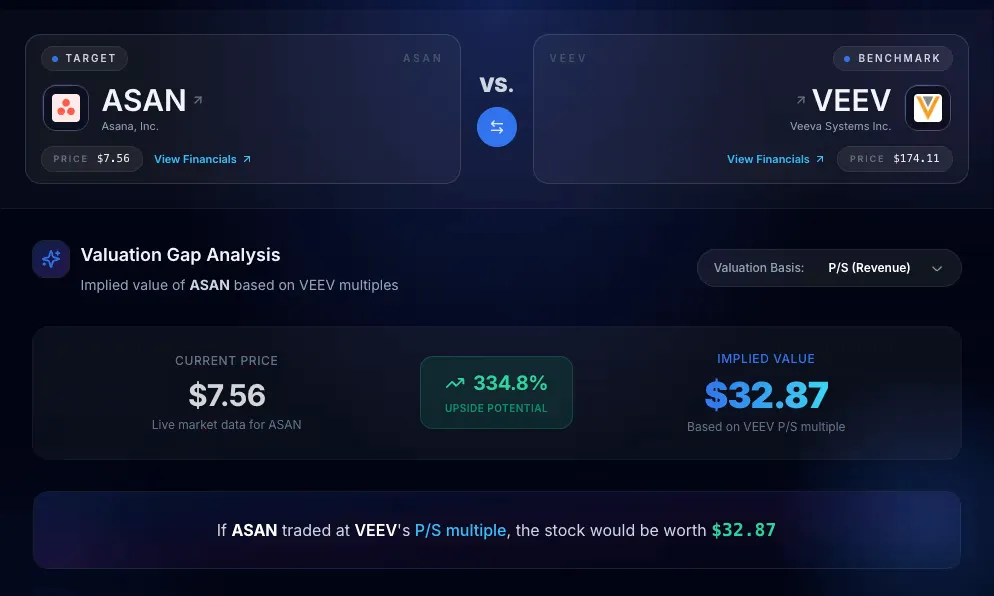
Conversely, consider a horizontal SaaS company like Asana (ASAN), which provides project management tools across many industries. While Asana has integrated AI features to improve its product, its core functionality is facing an existential threat from hyperscalers like Microsoft and Google. As AI assistants become more deeply embedded in core productivity suites (e.g., Microsoft 365 Copilot, Google Workspace), the need for a standalone, horizontal project management tool may diminish for many customers. This risk of being commoditized or bundled away by larger platform players is a primary driver of the multiple compression seen in this segment. The market is signaling uncertainty about their long-term pricing power and competitive positioning.
Discerning investors can use Edwyn to systematically validate this thesis and find opportunities.
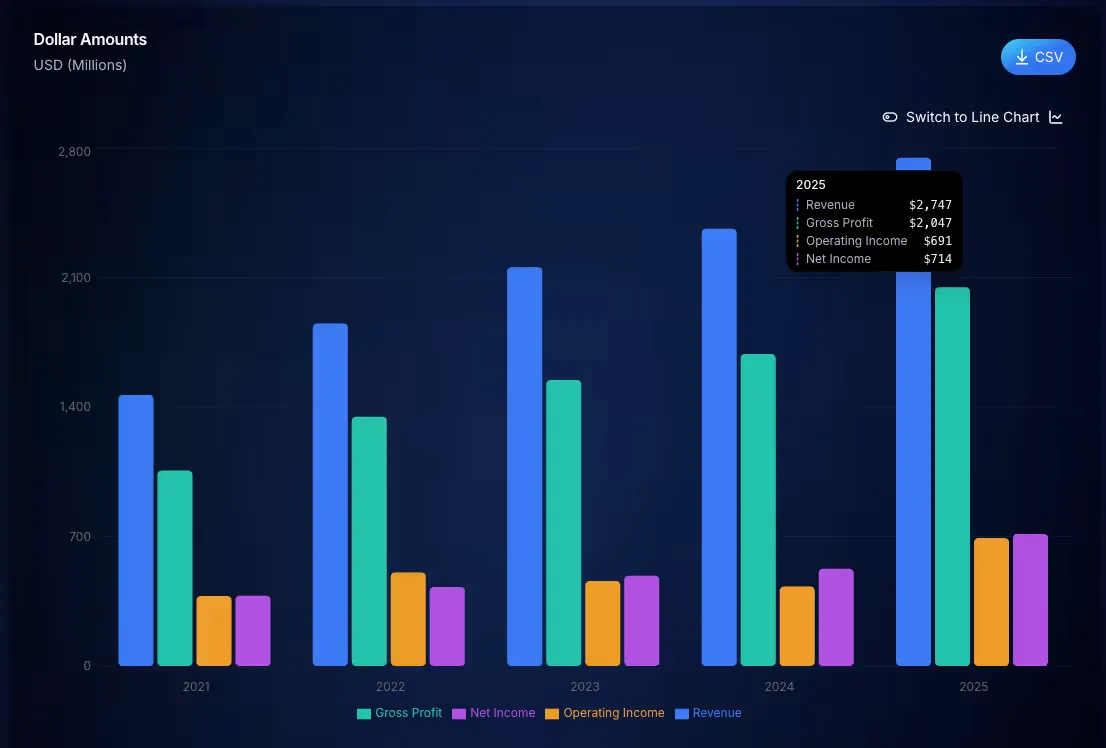 Veeva's superior gross margins and consistent R&D spend, easily viewed in Edwyn, are financial proof of its strong market position.
The bifurcation in SaaS valuations is a rational market response to the evolving technological landscape. AI is acting as an accelerant, rewarding companies with deep, defensible moats built on proprietary data and specialized workflows, while punishing those whose value proposition can be easily replicated. For analysts and investors, the key is to look past the AI buzzwords and use robust tools to analyze the underlying strength and durability of the business model. The companies that can prove their indispensability in the age of AI will continue to command premium valuations and deliver long-term value.
Put this analysis into practice using Edwyn's core valuation toolkit: